Welcome to the first newsletter from ATTENT10N - a new brand focused on attention science in the AI age. Our goal is to make sense of that AI madness so brands can navigate the future confidently. No more soup - only clarity.

Most marketers know Kahneman.
System 1 - fast, instinctive, the gut feeling that makes you grab one brand over another without knowing why.
System 2 - slow, deliberate, the spreadsheet brain that kicks in when you’re comparing mortgage rates.
Two systems. Two speeds of thinking. The entire behavioural economics playbook for the last twenty years has been built on this model.
There’s now a third. And it runs before either of them even switches on.
A group of Italian researchers - led by Giuseppe Riva at the Catholic University of the Sacred Heart in Milan - published a paper in Nature Human Behaviour proposing something they call System 0. It’s since been expanded into a full research paper and, as of last month, a new article in the Harvard Data Science Review applying it directly to brand strategy and the attention economy.
Here’s the core idea: AI systems now function as a cognitive preprocessor. Before your customer engages their intuition (System 1), before they engage their reasoning (System 2), an AI layer has already filtered, ranked, and shaped what they see. System 0 isn’t a metaphor. It’s a description of what happens every time someone asks ChatGPT for a recommendation, gets a Perplexity summary, or lets Google’s AI Overview answer their question instead of clicking through.
The researchers arrived at this through a beautifully simple observation. Riva and a colleague were in Los Angeles trying to find somewhere to eat. Both pulled out their phones. Both opened Google Maps. The lists were completely different - personalised, filtered, pre-decided by an algorithmic layer neither of them had consciously activated. AI had already shaped reality before either of them started thinking about what they wanted.
That’s System 0. The thinking that happens before you think.
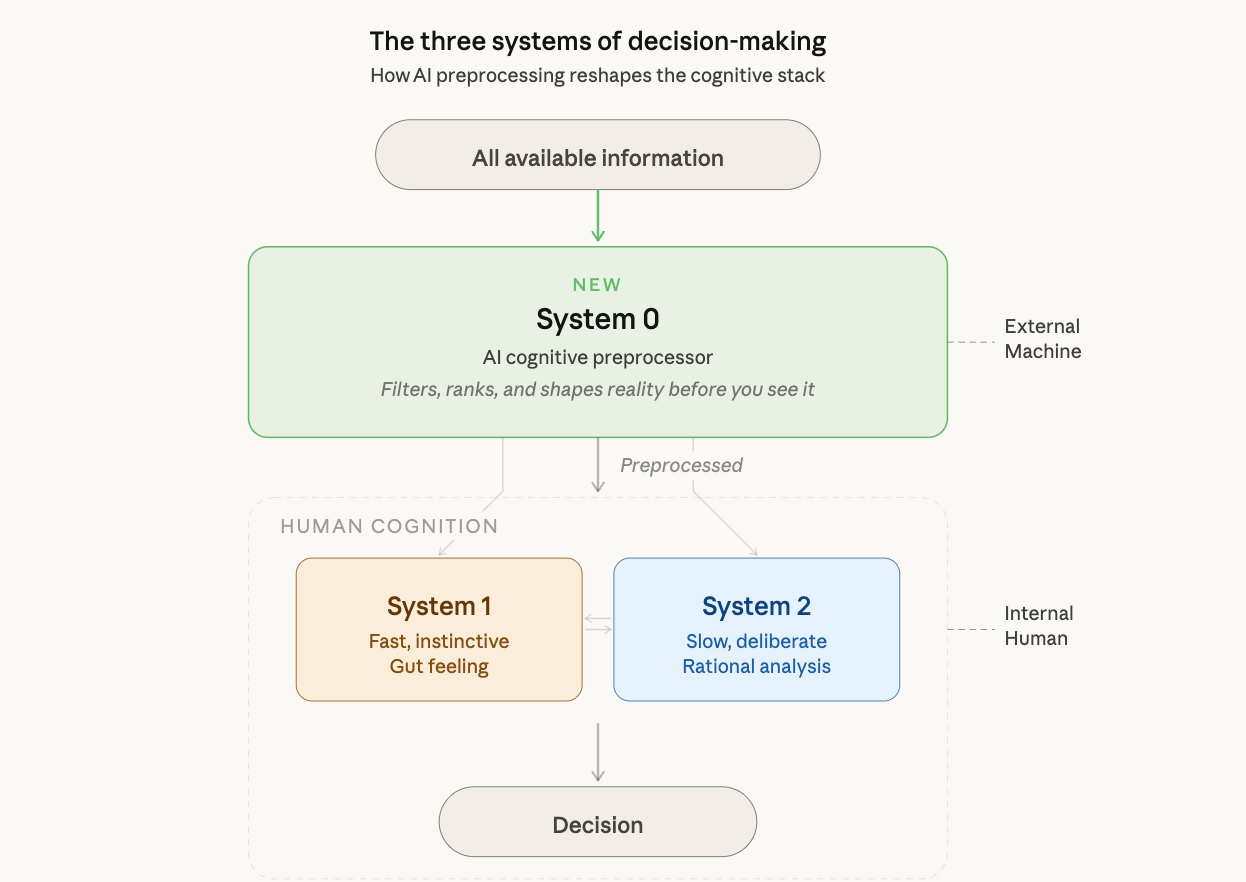
When I first came across this research, my marketing brain did something it hasn’t done in a while - it genuinely stopped. Not because the concept was unfamiliar. I’ve been building a diagnostic platform around this exact thesis for months. But because someone had finally given academic language to the thing I’d been circling around intuitively.
Here’s what I’d been working from: the idea that AI visibility isn’t an SEO problem. It isn’t a content marketing problem. It’s an attention problem and specifically, it’s a problem that lives upstream of every other marketing activity. If your brand doesn’t exist clearly in the AI layer, nothing downstream matters. The decision has already been pre-processed without you.
System 0 is the academic framework that explains why.
What makes System 0 different from the tools we’ve always used - search engines, social algorithms, recommendation engines - is that it’s generative. It doesn’t just filter existing information. It actively processes, transforms, and creates new representations of information, often in ways that are unpredictable to both the people using it and the companies that built it.
This is the non-determinism problem I’ve been banging on about. Ask three different AI systems the same question about your brand and you’ll get three different answers. Ask the same AI system three times and you might get three different answers. The researchers explicitly flag this: System 0 is “non-deterministic and opaque” - it resists full transparency.
For the AEO and GEO crowd, this is a fundamental problem. You can’t optimise for an output that changes every time you measure it. The entire industry of monitoring what AI says about your brand is built on quicksand.
System 0 has a critical constraint: limited semantic capacity. It’s extraordinary at statistical pattern recognition, but it can’t independently interpret meaning. It’s dependent on what you give it to work with.
The AI doesn’t fix your narrative. It doesn’t clean up your inconsistencies. It doesn’t resolve the fact that your brand says one thing on your website, something slightly different on social, and something else entirely in your reviews. It takes whatever signal - or noise - you’ve put into the world, and it preprocesses reality from that.
Incoherent brands create incoherent preprocessing. Your customer’s System 0 is assembling a picture of you from whatever fragments it finds. If those fragments contradict each other, the picture it builds will be confused. And a confused System 0 doesn’t recommend you. It moves on.
The Harvard Data Science Review paper proposes a framework they call AI Optimisation, or AIO - four steps: structured data for AI parsing, real-time performance tracking, mastering contextual relevance, and AI personas. It’s a good framework. It’s also incomplete.
It tells you how to optimise for System 0. It doesn’t tell you what System 0 currently thinks about you. And you can’t optimise what you haven’t diagnosed.
Before you optimise, you need to know: Does System 0 even find you? (That’s discoverability - does AI surface your brand when someone asks a relevant question?) Does System 0 trust you? (That’s authority - are there verification signals, reviews, and consistency that make AI confident in recommending you?) Does System 0 describe you correctly? (That’s representation - when AI talks about your brand, does it say what you’d want it to say?)
Found → Verified → Described correctly. That’s the diagnostic sequence. And most brands haven’t done step one.
Here’s the thing the researchers don’t quite say, but the logic demands: if System 0 is non-deterministic - if it produces slightly different outputs each time - then the only way to build a reliable picture of where you stand is to measure it multiple times and look at the variance.
That variance isn’t a bug. It’s the most important signal you have. The AEO products in the market actually do this if you read their methodologies - it is the only way to provide some predictability in a non-deterministic landscape.
A brand with high consistency across multiple System 0 queries has strong, clear inputs. The AI keeps arriving at roughly the same answer because the underlying signal is coherent. A brand with high variance has noisy inputs - the AI is essentially guessing differently each time because there’s no stable foundation to draw from.
You can measure that. You can score it. And you can track it over time.
One more thing happened in February that makes all of this more interesting…
OpenAI started running ads in ChatGPT.
The moment System 0 stops being a purely algorithmic preprocessor and becomes a paid media channel, everything shifts. Organic brand coherence - the stuff that got you into AI recommendations naturally - becomes dramatically more valuable. Because now there are two ways into System 0: you earned your way in through clear, consistent signals, or you’re buying your way in.
The brands that did the coherence work before ads arrived are the ones who won’t need them. Everyone else just got a very expensive invoice for years of narrative neglect.
Kahneman spent his career showing us that human decisions are shaped by cognitive processes we’re barely aware of. System 0 extends that insight into an era he didn’t live to see - one where the preprocessing isn’t happening inside our heads at all, but in an external layer we’ve collectively outsourced our attention to.
The fight for attention has always been about getting in front of the decision. System 0 means the decision now starts before the human even knows they’re making one.
This is why I think attention science will move to the forefront from a brand management and marketing perspective.