A few weeks ago I posted a framework I’d been working on. The AI Brand Architecture. A pyramid showing the three layers that determine whether AI can find you, understand you, and recommend you: Representation at the top, Signal in the middle, Brand Substance at the base.
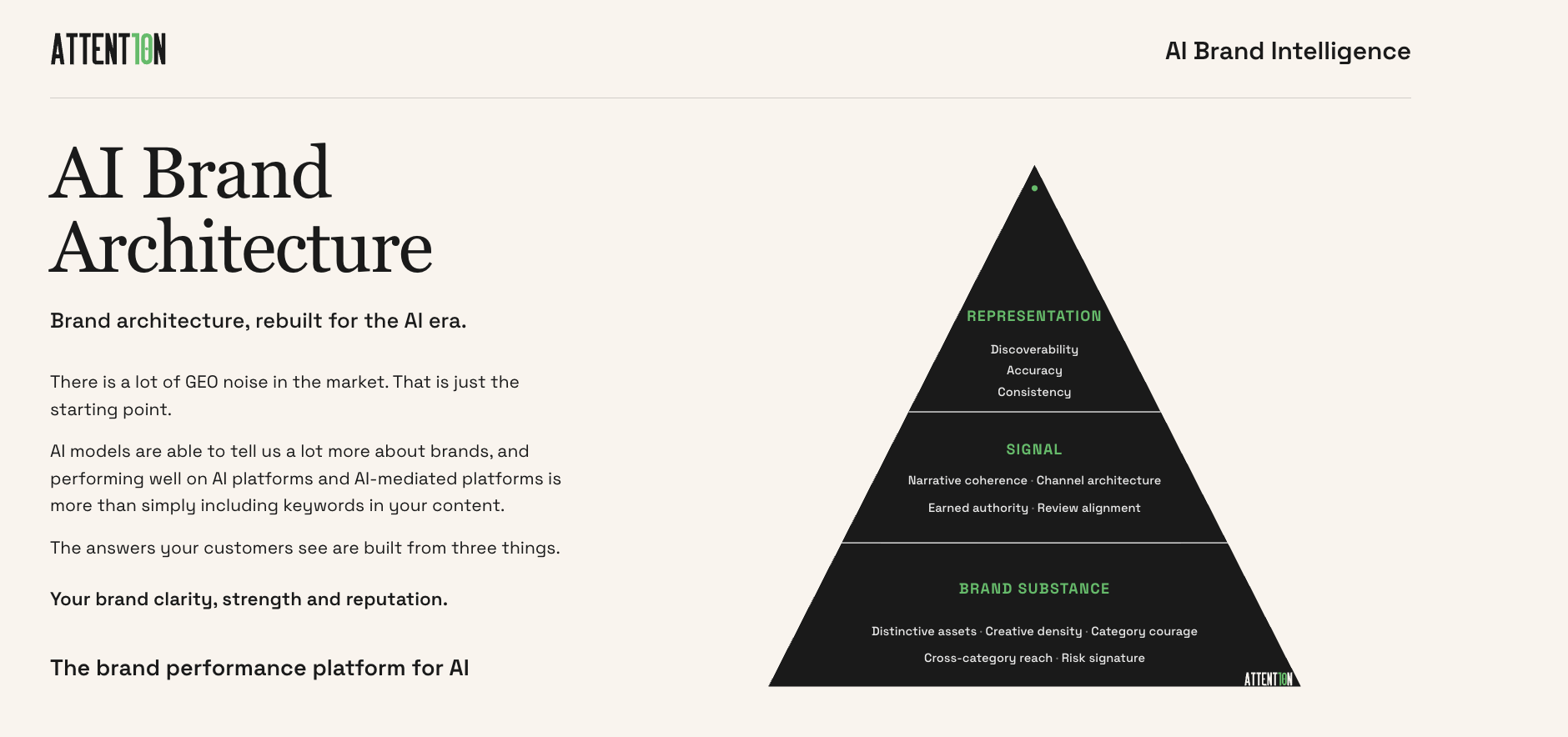
I paired it with the WARC data showing that long-term brand equity drives 63% of AI visibility. Not keywords. Not citations. Not prompt hacking. Brand equity.
The post reached 31,000 people. The framework clearly resonated. But the question I kept getting in the comments and DMs was always the same: OK, but how does that brand equity actually get into the machine?
I am building a new platform that surfaces all of this information as the future of marketing for AI is not as simple as writing 100 articles with your product details.
Ahrefs analysed 76 million AI Overviews. They measured how strongly different signals correlate with whether a brand gets cited in AI responses. Two numbers stood out.
Brand mentions across the web correlate 0.664 with AI citation probability.
Backlinks correlate 0.218.
That’s a 3:1 ratio. The signal that SEO built its entire industry around (backlinks, domain authority, link equity) matters three times less than whether people are simply talking about you.
The answer is community
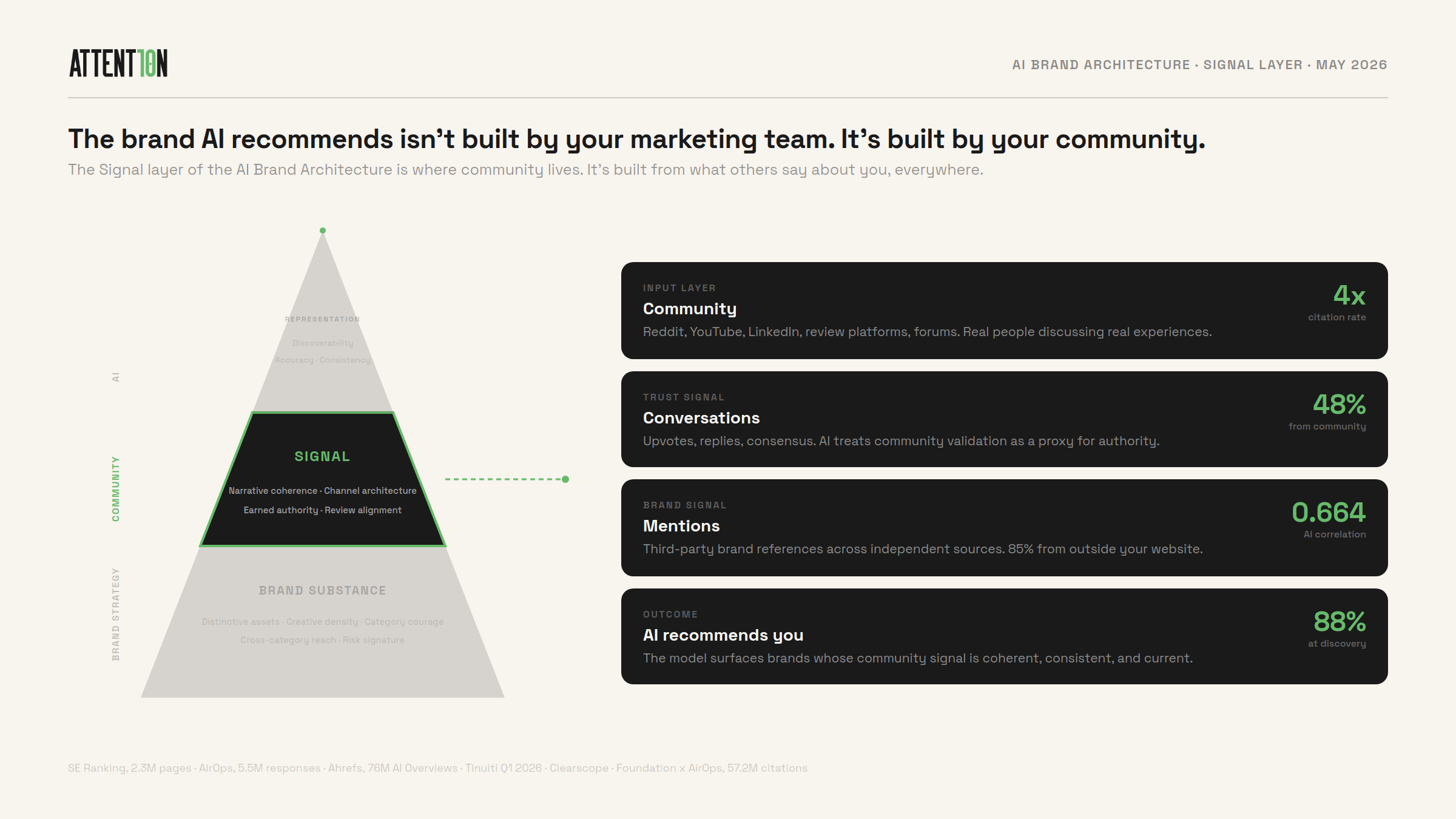
Foundation Marketing and AirOps tracked 57.2 million AI citations across 50 brands and five platforms over 60 days. 85% of the brand mentions that feed into AI citations come from third-party sources.
Reddit is the single largest citation source. 20.8% of all AI citations across six of seven verticals studied. For discovery queries, where buyers haven’t named a brand yet, Reddit climbs to 31%.
SE Ranking studied 2.3 million pages and found that brands with significant community presence on Reddit and Quora have 4x higher AI citation rates than those without it.
Clearscope found that brands mentioned positively across four or more non-affiliated forums are 2.8x more likely to appear in ChatGPT responses.
AirOps’ own 2026 State of AI Search report confirmed that 48% of all AI citations come from community platforms.
And Tinuiti’s Q1 2026 data revealed 88% of Reddit citations happen at the category exploration stage. Before a buyer has decided what to buy. The exact moment when AI is building the consideration set.
Why community, specifically
A backlink is a structured authority claim from one website to another. It says “this source is credible.” It’s a signal that can be manufactured, bought, and scaled artificially. AI systems know this.
A Reddit thread with 500 upvotes where real users discuss your product is something different. It’s a consensus signal from a community of actual humans. The upvotes, the replies, the correction patterns, the back-and-forth. AI systems treat community validation as a proxy for authority that no backlink can replicate.
This is why Google paid Reddit $60 million a year for access to its conversations. Not because Reddit has good SEO. Because Reddit has what AI models need most: authentic human discourse, voted on and validated by the people who actually use the products being discussed.
Starling has the highest LLM brand voice presence of any UK bank. Not because of their content strategy. Because of real user conversations happening organically across Reddit and LinkedIn. The community built the signal.
Mapping this onto the architecture
This is where the AI Brand Architecture framework I shared becomes useful.
Brand Substance (the base) is built by your brand strategy team. Distinctive assets, creative density, category courage, cross-category reach. This is the work of building a brand worth talking about. No amount of community engagement creates substance that doesn’t exist. You can’t fake this layer.
Signal (the middle) is built by your community. Channel architecture IS community surfaces. Narrative coherence IS whether what your community says about you aligns across Reddit, YouTube, LinkedIn, and review sites. Earned authority IS the trust signal that community validation creates. Review alignment IS whether customer experience matches brand promise. This entire layer is the domain of the people who use your product, discuss your brand, and validate (or contradict) what you claim to be.
Representation (the apex) is built by AI. It reads the Signal layer and produces discoverability, accuracy, and consistency. You don’t control this layer directly. It’s the output of the two layers beneath it.
What this means for brand strategy
The practical implication is significant. Most marketing teams are structured around creating and distributing brand-owned content. Websites, social feeds, ad campaigns, press releases. All of that still matters for human attention. But for machine attention, the content your community creates about you carries more weight than the content you create about yourself.
This isn’t an argument for abandoning brand-owned channels. Brand Substance, the base of the pyramid, is still the foundation. If you don’t have a product worth discussing, distinctive assets worth recognising, and a brand promise worth validating, community can’t help you. There’s nothing to amplify.
But if you do have substance, and most established brands do, the bottleneck isn’t content production. It’s whether your brand shows up in the places AI actually reads. Whether real people are discussing you in communities that AI systems trust. Whether the signal your community generates is coherent with the brand you’ve built.
The 68% of GEO practitioners who are still focused on self-published listicles are optimising for the wrong layer. Google started suppressing that tactic in January 2026, with documented visibility losses of 29-49% across roughly 30 affected sites. Meanwhile, digital PR drives 25% of all LLM citations and only 6% of practitioners invest in it.
What to watch for
AI platforms are moving toward intent-based citation. They’re matching source type to the specific query being asked. Community content makes the cut when there are simply no better answers available. The brands that invest in making sure their community has the context and motivation to discuss them accurately will compound their advantage.
The brands that keep talking to themselves on their own websites will keep wondering why AI doesn’t mention them.
This is the second post in a series on AI Brand Architecture.
The data in this post is drawn from Ahrefs (76M AI Overviews), Foundation Marketing x AirOps (57.2M citations, 50 brands, 60 days), SE Ranking (2.3M pages), Clearscope, AirOps 2026 State of AI Search, Tinuiti Q1 2026 AI Citations Trends Report, and NP Digital (200 practitioners).